
Professional associations rely on member participation to select leaders and make certain governance decisions. However, the election itself is often managed by one person or a small team balancing election administration with membership, communications, and other responsibilities.
Some association elections are relatively straightforward, such as an annual vote for a handful of leadership positions. Others involve multiple positions, different voter groups, or member votes on bylaws, dues, and other governance matters.
An online voting tool needs to reflect those rules without making the election unnecessarily difficult to administer. Eligible members should have a clear voting experience, and the association should be able to confidently stand behind the result.
Different Approaches to Leadership Selection
Leadership selection begins before the ballot opens. The process may include candidate recruitment, nominations, eligibility review, and preparation of candidate information before members are asked to vote.
The way associations select their leaders can also vary considerably, and some of those approaches are evolving. ASAE, the American Society of Association Executives, has highlighted a growing emphasis in some organizations on board competencies rather than strictly geographic or constituency-based representation. It has also identified interest in smaller, more diverse boards and, in some cases, the use of a single slate rather than a traditional contested election.
In practice, that can lead to very different online voting processes. Members might choose between candidates for a single position, select several people from a larger field, approve a proposed slate, or elect a representative for a particular group or region.
Voting Rights and Eligibility Can Vary
Professional associations may have membership categories with different voting rights. Eligibility may depend on membership type, good standing, professional designation, or other requirements established in the association’s governing documents.
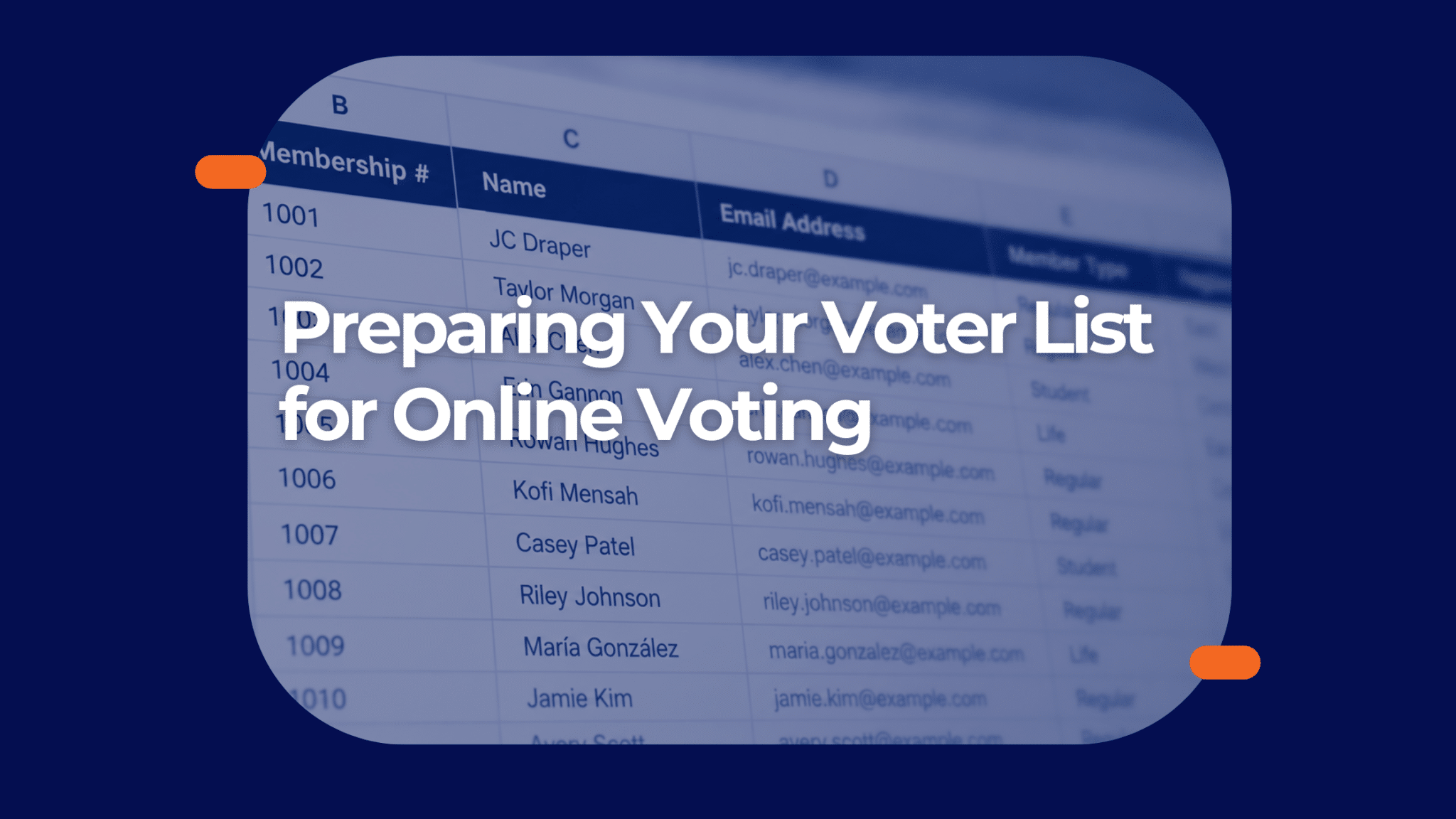
Before online voting opens, administrators need to translate those rules into an accurate voter list. That can mean confirming membership status, identifying the appropriate voter groups, removing ineligible records, and making sure the contact information being used for the election is current.
Some associations also have additional layers that affect voting eligibility or ballot access. Chapters, regions, professional sections, or specialty groups may have their own elected positions or voting rights. An organization might elect national leaders alongside regional representatives, conduct separate section elections, or have members who are eligible for several related voting events.
International associations may have further considerations, including multiple languages, geographically distributed members, and online voting periods that need to accommodate several time zones.
For an association with straightforward requirements, an online voting tool may only need one accurate voter list and one organization-wide ballot. When voting rights vary by membership category, region, section, or another rule, administrators may need more precise control over which voters receive access to particular positions or questions.
Eligibility is only one part of the association’s voting rules. Governing documents may also establish quorum requirements, approval thresholds, the number of candidates a member may select, or other conditions that affect how a particular election or member decision is conducted.
Together, these rules shape the online voting process, determining who can participate, what appears on each member’s ballot, and what is required for the result to count.
Election Administration Is Usually One Responsibility Among Many
The person responsible for an association election may use the online voting tool for a few weeks and then not return to it until the organization’s next voting cycle. Election administration is also likely to be only one part of a broader role that includes membership, communications, and other association responsibilities.
This reflects a broader reality of association management. CSAE, the Canadian Society of Association Executives, recognizes that internal capacity can vary widely between organizations, from associations with dedicated staff or departments to those where one individual may be the only staff resource.
This makes usability particularly important. An association’s election requirements may still be sophisticated, with different voter groups, ballot rules, or communication needs, but administering them should not require the person responsible for the vote to become a technical specialist.
Some associations will be comfortable administering their elections themselves. Others may prefer additional support or independent election management. The appropriate approach depends on the organization’s internal resources, governance requirements, and the role it wants an outside provider to play.
For a closer look at those different approaches, see our guide about who should run your online election.
A Familiar Process for Recurring Elections
Leadership elections commonly follow an established cycle as directors, officers, or other elected representatives complete their terms. Although candidates, dates, and voter information change, much of the underlying election structure may remain familiar.
That familiarity can be useful for the person administering the election. Processes, ballot structures, and lessons from a previous voting cycle can provide a starting point rather than requiring everything to be reconsidered from the beginning each year.
Associations can also learn from one election to the next. Questions from members, communication issues, or parts of the process that required extra attention can inform the next voting cycle.
Not every leadership change follows the expected schedule, however. A resignation or other vacancy may require a replacement process or special election to fill the position. In those situations, the association may be working from a familiar election framework while adjusting the timeline, position, voter group, or other details for the circumstances.
The Member Voting Experience
The way members experience an election can shape their confidence in the process. A clear, well-organized ballot helps voters understand the decision before them, know how to participate, and feel confident in exercising their voice on association matters. For members, online voting can make participation simple and immediate.
Professional association ballots may therefore need to provide more context than a list of names or a simple yes-or-no question. Candidate elections can include biographies, professional qualifications, statements, photographs, and information about the position being filled. Governance votes may instead require proposed wording, background information, supporting documents, or an explanation of what would change if the proposal is approved.
The surrounding voting experience matters as well. Members need to know when voting opens and closes, how to access the ballot, and where to get assistance if they encounter a problem. This can be particularly important when an association is introducing online voting for the first time.
For more on planning invitations, reminders, and other voter messages, see our guide to online voting communications before, during, and after an election.
Member Voting Goes Beyond Candidate Elections
Selecting directors, officers, or other representatives is a common reason professional associations conduct a vote, but leadership elections are not the only decisions that may be placed before members.
Members may also vote on bylaw or constitutional amendments, member resolutions, governance changes, dues or fee proposals, and other matters requiring formal approval. ASAE has noted that member voting rights can extend beyond leadership elections to significant organizational decisions. It has also highlighted bylaw votes as an opportunity to help members better understand how their association is governed and why proposed changes matter.
These decisions give members a direct role in matters that can shape the organization beyond who serves in its leadership positions. Online voting provides a straightforward way for members to exercise those formal voting rights, whether they are choosing association leaders or having a voice on a governance question placed before the membership.
What Should a Professional Association Look for in an Online Voting Tool?
Ultimately, a professional association needs to confidently stand behind both the election process and the final result. That requires more than simply collecting ballots online.
When evaluating an online voting tool, key considerations include:
- The association’s governance and voting rules. The system should accommodate the leadership selection methods, ballot formats, approval thresholds, and other requirements established by the association.
- Accurate voter eligibility and authentication. Administrators need to control who can vote and, when necessary, which positions or questions particular members can access.
- Ballot secrecy, privacy, and security. The system should protect member voting information and maintain the appropriate separation between voter participation and ballot choices.
- A clear and accessible member experience. Members should be able to understand and access the ballot across common devices, with candidate or proposal information and language options where required.
- Manageable administration. The system should provide the required flexibility without demanding unnecessary technical expertise from someone who may administer elections only periodically.
- Auditable and verifiable results. The election and its outcome should be able to stand up to scrutiny if members, candidates, or election officials raise questions after voting closes.
- Knowledgeable election support. When assistance is needed, administrators should be able to reach people who understand both the voting system and the practical issues that arise when running an election. The amount of support required may vary from occasional technical guidance to more hands-on election administration.
A strong fit makes the election practical to administer, clear for members, and credible when the outcome is reviewed.
Online Voting That Fits the Association
Professional associations vary widely in size, membership, governance structure, and internal resources. Their elections vary with them.
A practical approach to online voting accounts for both the association’s governance requirements and the realities of administering the election. A straightforward election should remain straightforward, while more involved governance requirements may call for additional flexibility.
Simply Voting is designed around that balance. Whether your association is electing its leadership, filling a vacancy, selecting representatives, or asking members to decide a formal governance question, the voting process should fit your organization.
Planning an Upcoming Association Election? Simply Voting offers online voting for professional associations, with both a self-service approach and assistance from our experienced Election Services team for leadership elections, bylaw votes, and other formal member decisions. Contact us today to discuss how Simply Voting can be your online voting partner.