
How long should online voting stay open? This is a question we sometimes hear from customers when planning their elections.
At Simply Voting, we support voting periods lasting less than 24 hours as well as elections that remain open for several weeks or longer. While we offer guidance based on our experience across a wide range of industries, the decision ultimately rests with the organization administering the election.
How long do online voting periods typically last?
Simply Voting analyzed more than 60,000 elections conducted using its online voting system between 2022 and 2026. More than a quarter lasted less than 24 hours, approximately two-thirds lasted less than a week, and 12% remained open for 15 days or longer.

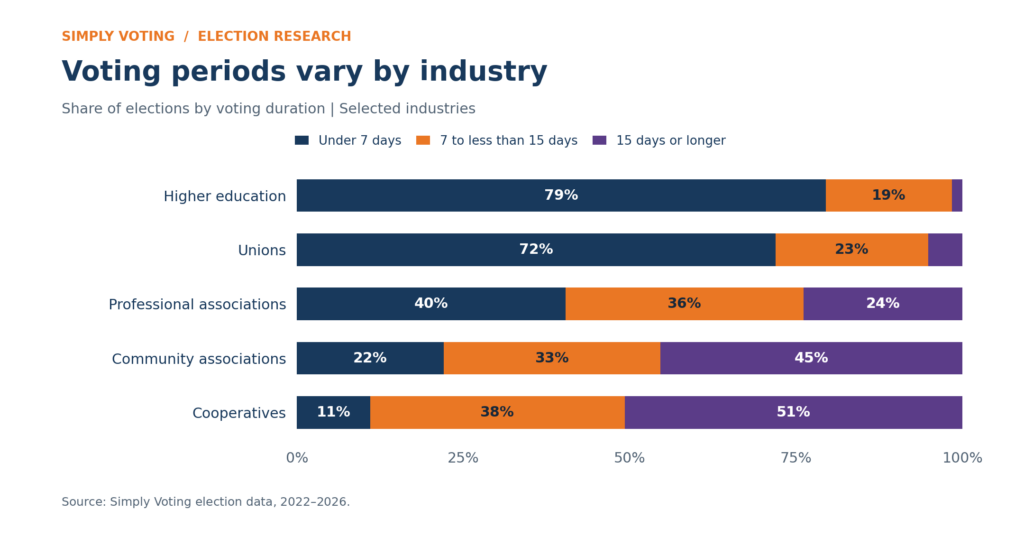
Voting practices differ considerably by industry. Nearly 80% of higher education elections and 72% of union elections had voting periods shorter than a week. By comparison, approximately half of cooperative elections and 45% of community association elections had voting periods of 15 days or longer.
These differences reflect the variety of elections and decisions taking place within these organizations, as well as the different electorates they serve.
Best practices for determining a voting period
Start by reviewing your organization's bylaws, constitution, election policies, or other governing documents. These may establish minimum voting periods, advance notice requirements, minimum participation thresholds, or deadlines for announcing results.
Where election administrators have discretion, three considerations are particularly important:
- The nature of the election. A time-sensitive contract ratification vote may warrant a shorter voting period than an annual board of directors election.
- The electorate. Working schedules, academic calendars, geographical distribution, and how frequently voters engage with the organization can influence how much time they need to participate.
- Organizational deadlines. Work backwards from when results are needed, allowing sufficient time for any required review, approval, or announcement procedures.
As a general rule, where organizational requirements and deadlines permit, we recommend erring on the side of giving voters more time rather than less. A more generous voting period accommodates different schedules, unexpected commitments, and voters who may need assistance resolving issues with their voter records.
Choosing when voting opens and closes
In examining online elections conducted using Simply Voting since 2016, we found that nearly nine in ten opened on a weekday. Monday was the most popular opening day, and Friday was the most popular closing day. Among elections lasting at least 24 hours, approximately seven in ten included weekend voting.
Simply Voting automatically opens and closes elections at their scheduled times. We recommend considering administrator availability to address initial voter inquiries and when the organization intends to review its results. For multi-day elections, consider including a weekend to give voters greater flexibility. Across the elections we support, we see voters taking advantage of online voting's around-the-clock availability, casting ballots before work, during lunch breaks, in the evening, and late at night.
Should circumstances change after voting has begun, Simply Voting allows administrators to extend the voting period. Any extension should be consistent with the organization's election rules and the revised deadline clearly communicated to voters.
Voting duration, communications, and turnout
While a longer voting period gives voters more opportunities to participate, it does not necessarily translate into higher turnout. The significance of the election to voters, the choices on the ballot, and their engagement with the organization are also important factors.
In our experience, well-timed election communications are particularly effective at encouraging participation. We frequently see a spike in voting activity when the initial invitation to vote is sent, followed by further increases as reminders go out. A reminder sent on the day before voting closes or on the final day itself can prompt another surge in participation.
Simply Voting's online voting system allows administrators to monitor turnout and send targeted email reminders to voters who have not yet cast their ballots.
We recommend planning your election communications alongside your voting dates. Space reminders throughout the voting period and give voters sufficient time to act on them before voting closes.
For more guidance, see our article on planning online voting communications.
Online voting on your organization's schedule
Where organizational requirements permit, give voters ample time to participate and make effective use of that time through well-planned election communications.
Since 2003, Simply Voting has helped organizations across a wide range of industries conduct elections according to their own schedules and governance requirements. Our online voting system gives administrators control over their voting schedules, communications, and participation monitoring, backed by an experienced team of election professionals.
Planning your next election? Contact Simply Voting to discuss your organization's election requirements.