Supporting 73 Ontario Municipal Elections with Online Voting

On October 26, 2026, 73 Ontario municipalities completed elections supported by Simply Voting. Across those municipalities, more than 1.2 million electors were eligible to vote, and more than 453,000 votes were recorded.

The work behind election day had been underway since early 2026, with each municipality supported by a dedicated Simply Voting project manager through preparation, configuration, testing, voter communications, active voting, and post-election reporting.

Throughout that work, the online voting system needed to be secure and reliable, the project needed to stay on track, and municipal staff, candidates, and voters needed confidence in the process and its results.

Preparing for Election Day

Preparation began with kickoff meetings, requirements gathering, voting website configuration, contingency planning, training, guides, and how-to-vote videos tailored to each municipality’s voting configuration.

As the projects moved into their final stages, municipalities reviewed their proof of concept to confirm ballot wording, voting rules, instructions, and the voter experience before candidate lists were official.

Municipalities also received assurance material including independent third-party penetration testing and accessibility audits, Simply Voting’s SOC 2 audit, and load-testing results. This built on work ahead of the 2026 cycle, including Simply Voting’s participation in developing CAN/DGSI 111-1:2024, Canada’s standard for online electoral voting in municipal elections, and implementation of the requirements applicable to its online voting system.

Once candidate lists were official, municipalities conducted Logic & Accuracy testing by casting scripted test ballots and confirming that calculated results matched expected outcomes.

Voter Information Letter production required finalizing voter data, copy and approvals while working backward from desired in-home dates. Across the 73 elections, more than 1.2 million Voter Information Letters were mailed.

Dedicated Project Management Through the Election

Simply Voting’s project managers worked directly with their assigned municipalities, with the Elections Director overseeing the work across all 73 projects. Project managers tracked requirements, approvals, deadlines, and next steps while remaining the municipality’s primary Simply Voting contact.

When additional expertise was needed, they coordinated with the rest of the Simply Voting team, including IT and other specialists.

Deep River’s feedback reflected the value of that structured project management approach:

“Thank you to the team at Simply Voting for once again working with the Town of Deep River on another successful, seamless election.

Elections are stressful, but one thing I never have to worry about is Simply Voting’s proficient management of the voting process.

The detailed Project Plan that outlines requirements, tasks and deadlines is excellent for pre-planning and keeping the election process organized and on track; the Election Manager and voting process are user friendly, and the dedicated Project Manager’s prompt and knowledgeable assistance were and are greatly appreciated.” — Jackie Mellon, Clerk, Town of Deep River

Different Municipalities, Different Election Needs

Simply Voting provided internet voting to all 73 municipalities, while 57 also offered telephone voting. Some municipalities offered electronic voting exclusively, while others combined it with paper voting administered locally.

Across all 73 elections, approximately 87% of recorded votes were cast through the Internet voting system, about 6% by telephone, and about 7% on paper.

The municipalities also brought very different levels of experience with online voting. Forty-six had worked with Simply Voting in previous election cycles. Of the remaining 27, 24 moved to Simply Voting from another provider, while three were introducing online voting for the first time.

The Township of St. Clair was both new to Simply Voting and conducting municipal internet voting for the first time.

“This was my first time using this voting method, and I’ll be recommending that our council adopt this format going forward. This is entirely a result of how well everything ran. The training materials were fantastic, and our Project Manager was a rockstar. I had countless questions, and the prompt and attentive responses I received every time I reached out made all the difference.” — Jeff Baranek, Clerk, Township of St. Clair

Election Day Was an All-Hands Effort

By the time voting opened earlier in October, ballots had been configured and tested, Voter Information Letters had been delivered, integrations were in place, and municipal teams had worked through months of preparation.

Throughout the voting period, project managers stayed in close contact with municipal clerks while Simply Voting teams monitored turnout, infrastructure, integrations, and incoming questions.

On October 26, the final day of voting for all 73 municipalities, that work shifted into an all-hands effort. That included monitoring real-time synchronization between municipal voter-data systems and Simply Voting’s online voting system, with IT and Elections staff available to investigate and respond when needed.

More than 147,000 votes were recorded across the 73 municipalities on October 26 alone, representing nearly one-third of all participation across the full voting periods. Almost half of all votes were cast during the final three days, with hundreds of votes per minute being recorded during the final voting hours.

As voting concluded, attention shifted to final checks and making unofficial results available to municipalities so clerks could publish the results. In the days that followed, Simply Voting provided final results reports and additional election statistics, including turnout information.

A Decade of Growth in Ontario

Simply Voting’s Ontario municipal work has grown from four municipalities in 2014 to 28 in 2018, 50 in 2022, and 73 in 2026.

All four municipalities first supported in 2014 remain Simply Voting customers today, including the Town of Deep River, which has worked with us in every municipal election cycle since.

“We’re pleased to have supported municipalities across Ontario again this year,” said Brian Lack, President of Simply Voting. “These elections take a great deal of coordination between municipal clerks, our partners, and our own Elections and IT teams. I appreciate the work everyone put into delivering these elections.”

The Same Team and System Behind Your Election

The project managers who supported these municipal elections are part of the same Elections team that works with associations, unions, universities, professional bodies, cooperatives, and other organizations throughout the year. Those organizations use the same underlying online voting system, backed by the same independent testing, audits, security controls, accessibility work, and operational experience.

Whether supporting a municipality or another organization, our project managers bring the same structured preparation, responsive communication, and practical election experience to the work.

We appreciate the municipal clerks, election staff, partners, and Simply Voting team members who worked together throughout 2026 to help deliver elections people can trust.

Considering online voting for an upcoming election? Contact Simply Voting to talk with us about how our experienced project managers and online voting system can support your organization.
How to Evaluate the Security of an Online Voting System Provider

Choosing an online voting system provider is a consequential decision. In most cases, that responsibility will fall to one person or a small group balancing election planning with many other responsibilities. They may know security is important, but it is not always obvious how to evaluate the security practices behind an online voting provider’s claims.

You can make better decisions by looking for credible proxies and asking a small number of revealing questions. These signals can tell you a great deal about how seriously an online voting provider approaches security and how much evidence sits behind its claims.

Security is only one part of choosing an online voting system provider. We have a separate guide to choosing an online voting provider that looks at the broader decision, including election requirements, administration, support, and reporting. Here, we are going deeper on security.

Look for Independent Security Assurance

If you do only one thing to evaluate an online voting provider’s security, start by looking for credible independent security assurance.

You aren’t in a position to evaluate every part of an online voting provider’s security program yourself, and that is okay. Independent third-party scrutiny gives you another source of evidence. A security-conscious online voting provider should already be engaging qualified third parties to examine important parts of its practices and technology. As a buyer, you can use that work instead of relying only on the company’s own claims.

Independent security reviews can take different forms. Specialized auditors may examine whether a company has appropriate security controls and processes in place, such as how access is managed, risks are assessed, incidents are handled, or business continuity is planned. Other security specialists focus more directly on the technology, such as examining source code for potential weaknesses or actively testing a system to see whether vulnerabilities can be found and exploited.

These reviews answer different questions, so it is useful to understand what was actually examined. The organization behind the review matters too. Look for an established auditor or security firm with a meaningful track record, ideally one that regularly performs similar work for other established organizations.

A-LIGN SOC 2Simply Voting recently completed its 2026 SOC 2 examination with A-LIGN, an established cybersecurity compliance firm that reports having completed more than 36,000 audits for more than 6,400 clients globally. Simply Voting’s examination covered controls relevant to Security, Availability, and Confidentiality for its Online Voting and Internet Elections Services System.
Look at How the Online Voting Provider Approaches Security

Much of what you initially learn about an online voting provider will come from its website, proposals, and conversations with its team. Independent assurance is valuable because it can corroborate parts of that story rather than leaving every security claim self-reported.

It is also useful to understand who within the online voting provider is responsible for security and what resources support that work. Does the company maintain an in-house technical team that understands, maintains, and secures the platform, or are core technical responsibilities primarily outsourced? Outside specialists can provide valuable expertise, particularly for independent testing and other specialized security work, but the online voting provider itself should have clear ownership of its security and the technical capability to respond when something needs attention.

A mature security program involves much more than the technology itself. Staff security training, access management, risk assessment, vendor oversight, monitoring, vulnerability management, incident planning, and business continuity can all play a role.

A SOC 2 report can be particularly valuable here because it provides independent insight into many of these underlying practices. Simply Voting’s 2026 report, for example, covers controls across risk assessment, staff security training, access management, vendor oversight, monitoring, vulnerability management, business continuity, and other areas.

Price and company size are poor substitutes for evidence of how security is actually managed. A more useful baseline is understanding who owns security, what people and processes support that work, and what independent evidence supports the company’s description of its security program.

Security Starts Before Problems Are Found

Look for depth and multiple layers of prevention, review, and testing. No single test or security practice can identify every possible weakness. Using different approaches gives an online voting provider more opportunities to prevent problems and find those that do occur.

It starts with how the software itself is developed and maintained. Changes to an online voting system should be reviewed and tested before they reach customers, and the software and supporting systems need to be maintained as technology and security threats evolve.

Simply Voting follows a documented software development life cycle (SDLC) in which software changes are peer reviewed and tested before they reach production, with those change-management controls included in its 2026 SOC 2 examination.

Security testing can then examine the system from different perspectives.

Source-code scanning looks within the software itself for programming patterns or mistakes that could create security weaknesses. You can think of it as examining the application from the inside.

Vulnerability scanning checks the systems and software being used for known security weaknesses. Because new vulnerabilities are continually discovered in widely used technologies, this type of scanning can be performed frequently.

Independent penetration testing approaches security from another direction. Security specialists actively test the system and attempt to find and exploit weaknesses much as an attacker might. This can uncover issues that may not be apparent through development processes or automated scanning alone.

Simply Voting also conducts annual independent penetration testing, daily vulnerability scanning, and regular source-code scanning.

A vigilant security program also welcomes legitimate opportunities to find issues that those layers of testing may have missed. Outside security researchers can provide another valuable source of scrutiny, and a vulnerability disclosure program gives them a clear way to report a potential weakness so it can be investigated and addressed. Simply Voting maintains a formal vulnerability disclosure program because ongoing vigilance is important.

Ask how the online voting provider works to prevent security weaknesses, what different methods it uses to find them, and what happens when one is identified.

Understand How Voter and Election Data Is Handled

Look for a clear explanation of how customer information is handled from beginning to end. An online voting provider should be able to explain that lifecycle in terms you can understand.

An online election will require voter personally identifiable information (PII), participation data, election results, and other customer information. Where is it stored? Who can access it? How is access controlled? How is information protected while it is transmitted and stored? How long is it retained? What happens when it is no longer needed?

Election-specific protections matter as well. Voter authentication needs to support the requirements of the election, while ballot secrecy and confidentiality need to be maintained where required. Administrative access should also be controlled so that only authorized people can manage sensitive election information or settings.

It is also reasonable to ask which other companies are involved in storing, processing, backing up, or transmitting your information. An online voting provider may rely on hosting companies, backup services, communications providers, or other vendors. Part of managing security is knowing those dependencies, limiting access appropriately, and assessing the risks that come with them.

At minimum, you should be able to get clear answers about what customer information the online voting provider holds, who can access it, how it is protected, where else it may go, how long it is retained, and what happens when it is no longer required.

Security Includes Reliability and Availability

Look at how the online voting provider tests capacity, builds in resilience, and prepares for failures. Voters need to be able to cast their ballots, and customer administrators need to be able to access and manage their elections when the system is needed.

Online voting platforms support hundreds of elections at the same time. Load testing needs to consider demand across the platform as a whole, not just any one election.

Load testing places very heavy simulated demand on the platform to see how the online voting system performs under pressure and to help determine how much capacity should be available. Simply Voting regularly performs load testing to make sure the platform has far more capacity than it would normally require across all active customers, leaving ample room for spikes in usage.

Reliability also depends on the infrastructure underneath the application and what happens when something fails. Simply Voting uses established infrastructure providers, including Hut 8 for production hosting and AWS for offsite backups. This is supported by Simply Voting’s own monitoring, redundancy, backup practices, and tested business continuity and disaster recovery planning.

A useful check is how the online voting provider tests overall system capacity, what resilience exists in its underlying infrastructure, and how regularly its continuity and recovery plans are tested.

5 Security Questions to Ask an Online Voting System Provider

A detailed technical security review is not realistic for every organization, but a small number of practical questions can still reveal a great deal about the security practices behind an online voting system:

  1. What independent security audits or assessments do you undergo, who performs them, and what do they cover?
  2. Who is responsible for security, and what technical team and resources support that work?
  3. What ongoing practices do you use to prevent, identify, and address security weaknesses?
  4. How is customer, voter, and election data protected, who can access it, where else may it go, and how long is it retained?
  5. How do you test the online voting system for heavy demand, prepare for failures, and verify that the service can remain available or recover as planned?

Any online voting provider worth your business should be able to answer these questions and back up its claims with evidence.

Making a More Informed Security Decision

There is no single audit, test, feature, or policy that tells you everything you need to know about the security of an online voting system provider. A sound evaluation comes from asking good questions, looking for credible evidence, and understanding what sits behind the word “secure.”

Simply Voting’s broader security approach includes its 2026 SOC 2 examination, staff security training, a documented software development life cycle, annual independent penetration testing, ongoing vulnerability testing, a vulnerability disclosure program, load testing, and tested business continuity and disaster recovery planning.

Evaluating an Online Voting System Provider? Simply Voting has been helping organizations run secure online elections since 2003, supported by an ongoing program of independent review, security testing, load testing, and continuity planning. Contact us today to discuss your upcoming election and the security requirements that matter to your organization.

New Feature: Edit Scheduled Voter Email Blasts

We’ve added a new feature to our online voting system: scheduled voter email blasts can now be edited before they are sent.

Voter email blasts are messages sent from the Election Manager to eligible voters, such as election invitations, voting reminders, or other election-related communications.

Election administrators can now update the email body or adjust the scheduled sending date and time without cancelling the original message and creating a replacement. This makes it easier to correct last-minute details, clarify voting instructions, refine the wording of a reminder, or change when a message will be delivered.

How Does It Work?

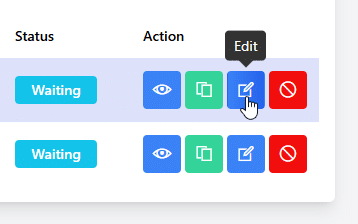
Navigate to the Email Blast section of your Election Manager. Find the scheduled email you want to update. Click the Edit icon in the Action column beside the email.

    Update the email body, scheduled date, or send time. Save your changes when you are finished.

    Once saved, the revised version will automatically replace the original scheduled message.

    Which Email Blasts Can Be Edited?

    Only voter email blasts scheduled for a future date and time that have not yet been sent can be edited.

    Messages that have already been sent cannot be changed.

    More Flexibility for Election Communications

    Election timelines and communication needs can change. You may need to correct a detail, update other important information, revise the wording of a reminder, or adjust when a message will be sent to voters.

    This update makes managing voter communications easier by allowing you to revise an existing scheduled message directly within the online voting tool in just a few clicks.

    For broader guidance on planning invitations, reminders, and other election messages, read our guide to online voting communications before, during, and after an election.

    Log in to your Election Manager to review or update your scheduled voter email blasts, or read our updated Help article on Managing Email Blasts.

    Vulnerability Disclosure Policy Now Live

    Security is foundational to what we do. Every election on our online voting platform depends on the integrity of the system running it, which is why we hold ourselves to a high standard when it comes to identifying and addressing vulnerabilities. Maintaining a secure online voting environment is essential to preserving trust in every election our clients conduct.

    Today, we are formalizing that commitment with the launch of our Vulnerability Disclosure Policy (VDP). The policy establishes a clear, structured process for security researchers to report potential vulnerabilities directly to us. It includes defined scope, safe harbor protections for good-faith researchers, and coordinated disclosure timelines consistent with ISO/IEC 29147, the internationally recognized standard for vulnerability disclosure.

    In practice, this means that when a vulnerability is discovered and reported to us, we have the opportunity to investigate and deploy a fix before any public disclosure. That protects our clients and the elections they run.

    Reports can be submitted to security@simplyvoting.com. Researchers may also encrypt sensitive findings using our PGP key.

    Read our Vulnerability Disclosure Policy →

    CAQ Leadership Election Successfully Conducted with Simply Voting

    Montreal, Canada – May 6th, 2026 – Simply Voting Inc., a leading provider of secure online voting solutions, is proud to announce the successful completion of the Coalition Avenir Québec (CAQ) leadership election using its voting platform.

    A Secure and Engaging Democratic Process

    From April 7 to April 12, 2026, members of the CAQ participated in a leadership vote to select a successor to François Legault, who announced his resignation in January.

    The election saw strong engagement from party members:

    • 15,833 members voted, representing 77% turnout
    • Total eligible members: 20,500
    • Voting officially concluded on April 12, 2026, at 15:00

    This high level of participation reflects both the importance of the leadership transition and the accessibility of the online voting system.

    Trusted Technology Delivering Reliable Results

    The election resulted in a decisive victory for Christine Fréchette, who secured 57.9% of the vote. As the CAQ is presently the governing party, Ms. Fréchette now becomes Prime Minister of Quebec. It was the party’s first ever leadership race.

    Members were provided the choice of internet voting or telephone voting, enhancing overall accessibility.

    To ensure a smooth voting experience, the online voting platform offered a dedicated help desk, enabling authorized personnel to assist voters encountering difficulties while maintaining strict safeguards to protect the integrity of the election.

    The online voting platform provided by Simply Voting ensured the highest standards of electoral integrity through:

    • Strong encryption
    • Anonymous electronic ballots
    • Instant and accurate tabulation of results

    CAQ emphasized the secured and user-friendly experience of Simply Voting’s online voting system and service. “Simply Voting’s expertise ensured the success of the CAQ leadership campaign by combining flawless technological security with a highly simple and accessible voting experience for all our members” said Denis Jr. Joannette, CAQ’s Director of Research and Development.

    The online voting system enabled party members from across the country to participate securely, reinforcing confidence in the democratic process.

    About the Coalition Avenir Québec (CAQ)

    The Coalition Avenir Québec (CAQ) is the current governing party in Quebec and has been in power since 2018. Focused on economic development, identity, and public service reform, the party plays a central role in shaping the province’s political landscape.

    Enhanced Telephone Voting for Secure and Scalable Elections

    We are pleased to announce an upgrade to our telephone voting solution, further enhancing accessibility, reliability, and security for our clients and voters.

    As you may know, Simply Voting offers a comprehensive range of election solutions, including online voting, paper ballots, and telephone voting, to ensure all your election needs are met. Our telephone voting system enables voters to cast their ballots through audio ballots, submitted securely using a touch-tone keypad, making it an essential option for accessible and inclusive elections.

    What’s Changed?

    Simply Voting now uses Twilio as the interactive voice interface layered on top of our online voting system.

    Twilio is a robust and leading cloud communications platform that adheres to internationally recognized security standards such as ISO 27001 and SOC 2 Type II, ensuring strong protections for partners like Simply Voting.

    What Are the Benefits?

    • More modern, more secure, greater capacity
      The upgrade focuses on the underlying communications infrastructure, delivering improved security and scalability.
    • Faster setup and turnaround
      Telephone ballots are easier and quicker to configure, reducing the lead time required to set up your election.
    • Easier audio updates
      Audio files can be adjusted quickly, making pronunciation corrections and other updates faster and more efficient.

    A Stronger, More Reliable Voting Experience

    This upgrade strengthens service continuity and reinforces trust for our clients. It delivers a smooth, secure, and scalable telephone voting experience that adapts effortlessly to demand ensuring every voter can cast their ballot without interruption, even during peak periods while maintaining the highest standards of data protection.

    Looking for an accessible telephone voting option for your election?
    Contact us to discuss your needs or read more about it here.


    Giving Back to the Community in 2025

    We’re thrilled to announce our corporate volunteering initiative for 2025! This year, we partnered with Sun Youth for the second time, a dedicated charity that provides a wide range of emergency and community services. Simply Voting also offered Sun Youth a $15,000 donation.

    This year, Simply Voting also decided to support DESTA Black Youth Network, a Non-Profit organization that supports Black youth aged 18 to 35 in reaching their educational, employability, and entrepreneurial goals with a $15,000 donation.

    The Volunteering Activity

    On December 10th, 2025, our team gathered at the Sun Youth warehouse to help where needed. Our team bagged oranges from 50kg sacks into smaller portions so they could be distributed to families in need.

    These tasks are essential to ensuring that Sun Youth’s programs run smoothly and that they can continue making a positive impact on those in need.

    That day offered a valuable opportunity for our team to make a positive impact, support a worthy cause, and connect more closely with one another.

    Thank you to everyone who participated and generously shared their time and energy to help make this initiative a success. Together, we made a meaningful impact and reinforced our commitment to our community.

    We look forward to our next opportunity to give back!

    Volunteering Activity 4
    Volunteering Activity 2025
    Volunteering Activity 3
    Volunteering Activity2

    2025 Holiday Support Hours Schedule

    Please note that our office will be closed from December 22, 2025 through January 2, 2026. Our normal hours will resume on Monday, January 5, 2026.

    Skeleton staff will still be available to support our customers. If you require emergency support during this time, please log into the Election Manager, click on the Help button in the bottom right corner of the page, and set the priority to “urgent”. One of our team members will follow up with you promptly.

    As this year comes to a close, we would like to thank all our clients and partners for your continued trust and support throughout the year. We value the opportunity to continue delivering a secure, reliable, and accessible online voting system for your elections year after year. Your confidence in Simply Voting inspires us to keep improving security and reliability, while developing new features to make user and voter experiences smoother.

    During the holiday break, while our office will be closed, our team will remain available to assist with urgent matters, ensuring your elections and voting processes run smoothly. Whether you’re planning for an upcoming election or need immediate support, we’re here to help.

    We wish you a joyful and successful New Year and look forward to supporting many more of your elections ahead.

    From all of us at Simply Voting, we wish everyone a safe and happy holiday season, and a very democratic New Year!

    Protecting Your Elections: Simply Voting Renews SOC 2 Type I Certification

    Each year, Simply Voting undergoes an independent SOC 2 Type I audit to evaluate the strength of our security and operational controls. We’ve recently completed our latest annual assessment, reaffirming that our systems and practices meet the rigorous Trust Services Criteria established by the American Institute of CPAs (AICPA).

    What the SOC 2 Type I Compliant Process Entailed

    To maintain our security commitment to our customers, Simply Voting partnered with A-LIGN, an independent auditing firm renowned for its expertise in compliance assessments. The audit involved:

    • Comprehensive interviews with our team,
    • Thorough examination covering 181 pieces of evidence, and
    • Rigorous review of our company’s administration, online voting system, and underlying server infrastructure.

    The resulting audit report confirmed that Simply Voting meets the SOC 2 Trust Services Principles for Common Criteria/Security, Availability, and Confidentiality. This demonstrates our commitment to providing reliable and secure voting solutions to our clients.

    Why This Matters for Our Clients

    Maintaining SOC 2 Type I compliance is a testament to Simply Voting’s continued dedication to delivering secure and dependable internet voting solutions. We understand that our clients rely on us to safeguard their election processes and data, and this certification provides independent assurance that our systems are designed to meet their expectations.

    This milestone reinforces our ongoing commitment to transparency, accountability, and trustworthiness, core values that define Simply Voting’s mission to deliver secure, fair, and accessible voting solutions for organizations worldwide.

    For more information about our commitment to security or how our SOC 2 compliance benefits your organization and your online elections, feel free to contact us or visit our website.

    Our New Feature: Nominations

    We are excited to announce a new election type for our online voting platform: our new feature, nominations. 

    You can now collect nominations right inside Simply Voting before your election begins. No more juggling tools or manual steps, everything from nominations to final voting happens in one streamlined platform.

    It’s faster, easier, and keeps your entire election process all in one place.

    In a nomination election, electors can nominate any elector for one or more position(s) on a ballot. It can optionally include a confirmation period during which nominees can accept or decline their nomination(s) and provide a candidate statement and photo that will be incorporated into the final ballot.

    Election organizers can then save time setting-up the election using the nomination results to populate the final ballot. 

    How does it work?

    To set up a nomination election in the Election Manager tool, simply create a new election:

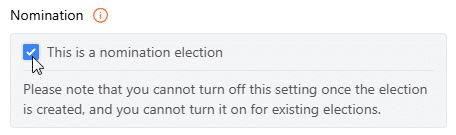
    Select “Nomination” as the type, and check the box labeled “This is a nomination election.”

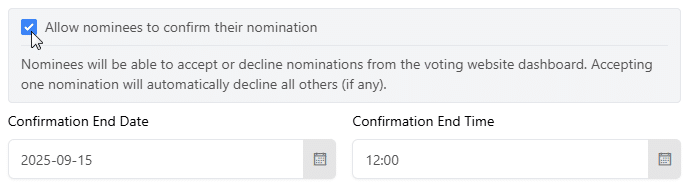
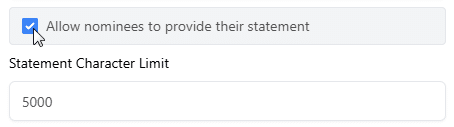
    In the Election Manager tool, you designate a new election as a nomination event, and then determine nomination settings such as if nominees are allowed to accept or decline nominations, and if candidate photos and statements can be provided.

    You will also need to upload your list of electors and indicate the positions that will be on the ballot. Like any other election, you will also schedule an email blast, proof the ballot and finalize the election. 

    Once your electors have nominated candidates and the election is finished, all nominees will be listed on the nomination results page. If applicable, you will then allow nominees to confirm their nomination and add their statement and photo.

    Once you are done processing nominations (and once the confirmation period is finished, if applicable), you will need to “click” on “populate” to create the election ballot.

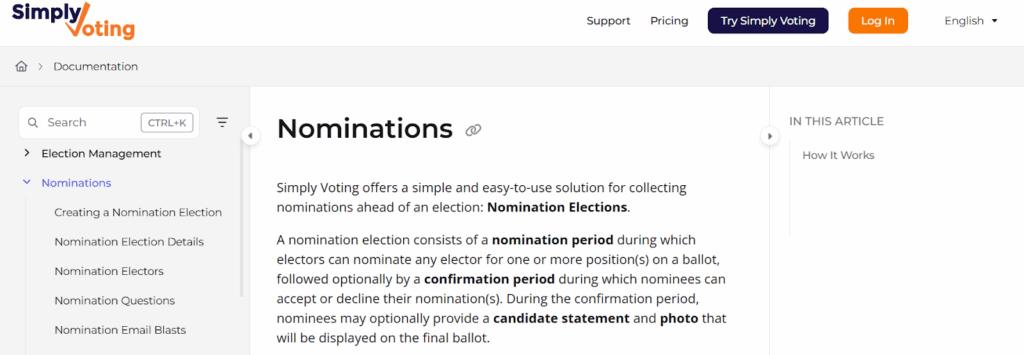
    For more information about managing a nomination election, see https://help.simplyvoting.com/docs/en/nominations

    This new feature allows you to run your nomination process and election on the same platform while facilitating your nomination process and simplifying your ballot setup. 

    Log in to your Election Manager now to start setting up your next nomination election.